The TransferWise pitch deck from May 2011 is a remarkably lean document that prioritizes operational clarity over aesthetic flourish. At a time when international money transfers were opaque and expensive, founders Kristo Käärmann and Taavet Hinrikus presented a straightforward peer-to-peer model. The deck succeeds by distilling a complex technical and regulatory challenge into a four-step user journey and leveraging the founders' significant pedigree—specifically Hinrikus's role as an early Skype employee. While the provided slides lack specific financial projections or a detailed competitiv…
Key takeaways
- The deck identifies the core product as 'Peer-to-peer currency exchange' on the title slide, dated 31.05.2011.
- A four-step process slide explains the mechanics: booking a payment, depositing money, automatic matching at mid-market rates, and delivery to the recipient.
- The roadmap slide categorizes growth into Segments, Currencies, and Marketing, showing intent to move into B2B and API services.
- The team slide highlights Taavet Hinrikus's background as a 'Skype early employee' and Kristo Käärmann's experience at Deloitte and PwC.
- The product screenshot on slide 2 explicitly shows a price comparison, claiming a user 'will save €27.56' compared to a high street bank.
- Marketing strategy is initially focused on 'Word of mouth' and 'Targeted PR' rather than heavy paid acquisition spend.
- The deck omits a specific 'Ask' slide or detailed financial unit economics in the provided 6-slide selection.
- The visual design is extremely minimalist, using a basic orange and grey color palette with significant white space.
Introduction: The Power of Simplicity in Fintech
The TransferWise (now Wise) pitch deck from 2011 is often cited as a benchmark for early-stage fintech fundraising. At the time, the company was seeking to disrupt a massive, entrenched industry dominated by global banks. The deck does not rely on complex financial modeling or flashy graphics. Instead, it focuses on a clear problem, a transparent solution, and a team that looks capable of executing a difficult technical and regulatory roadmap. This teardown examines the 6 slides provided from the original 11-slide deck.
Slide 1: Title and Positioning
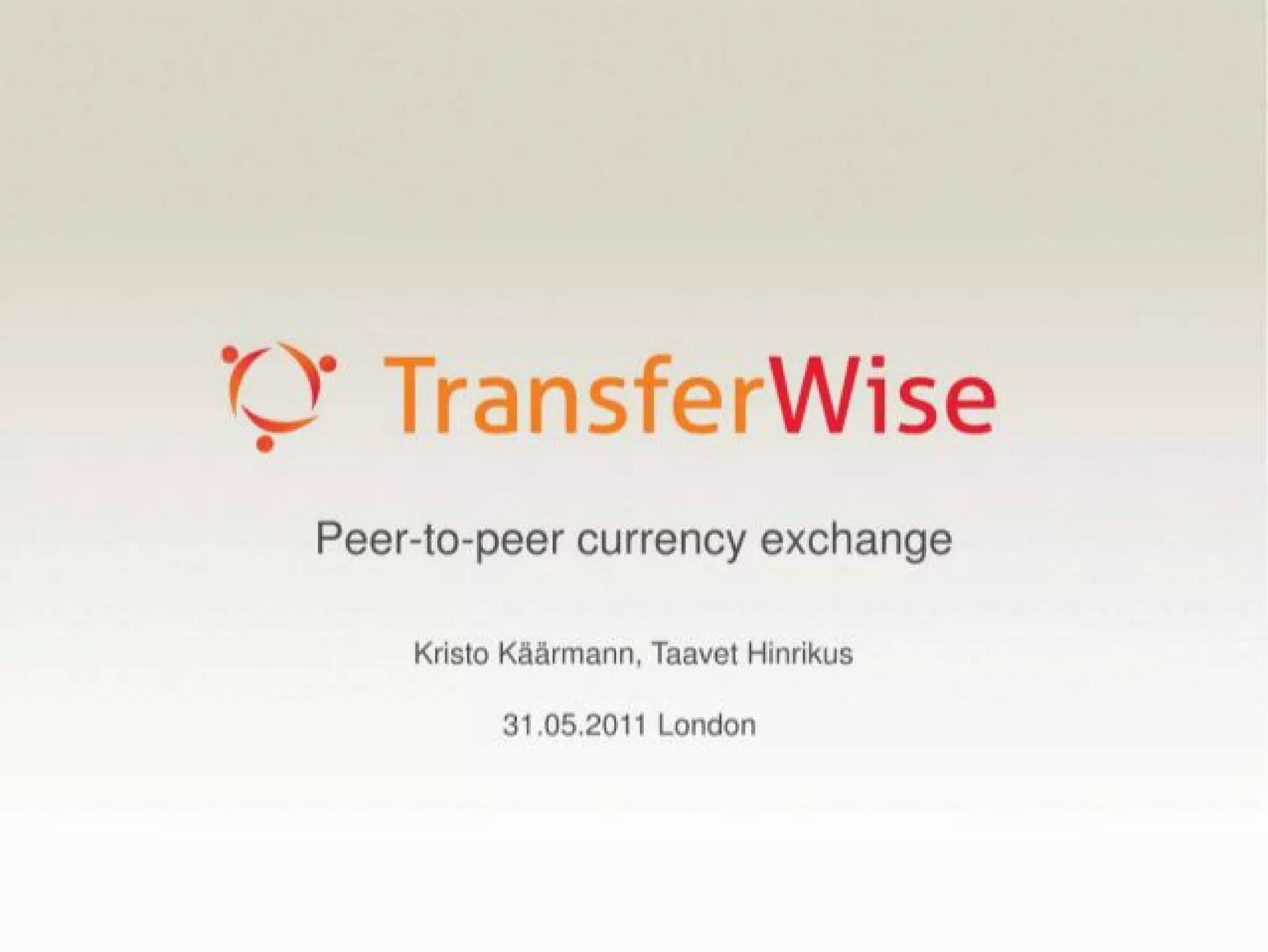
The title slide is functional and direct. It identifies the company name, the two founders (Kristo Käärmann and Taavet Hinrikus), and the date: 31.05.2011. The most important element here is the sub-headline: "Peer-to-peer currency exchange." By using the term 'peer-to-peer' in 2011, the founders were tapping into a successful tech zeitgeist popularized by companies like Skype and Napster. It immediately tells the investor that this is a technology-driven solution to a financial problem, not just a new type of bank.
Slide 2: The "How it Works" and Product Proof
This slide is the core of the deck. It uses a four-step list to demystify a process that most people find confusing. Step 1: Book a payment. Step 2: Deposit money. Step 3: Convert currency. Step 4: Send to recipient. The inclusion of a website screenshot is critical here. It proves that the product isn't just a concept—it is live. The screenshot specifically highlights a comparison tool where a user can see they "will save €27.56" compared to a high street bank. This is a powerful way to show the value proposition in action rather than just describing it in bullet points.
Slide 3: The Roadmap
The roadmap slide is divided into three categories: Segments, Currencies, and Marketing. This shows the investors that the founders have a logical sequence for growth. Under 'Segments,' they list Personal, Business payments, Invoicing, API, Card payments, and Remittance. This signals that while they are starting with personal P2P transfers, the ultimate goal is to become a full-stack financial services provider. The currency list (moving from GBP/EUR to USD/AUD/CAD) shows a clear path to global scale. The note at the bottom, "We are just scratching the surface, the todo list is long..." , acknowledges the early stage while projecting ambition.
Slide 4: The Team
For a seed-stage company, the team slide is often the most important. TransferWise wins here by highlighting two very different but complementary backgrounds. Kristo is positioned as the industry expert with "Financial services consulting with Deloitte and PwC." Taavet is positioned as the scaling expert, noted as a "Skype early employee, angel investor, INSEAD MBA." This combination of 'boring' institutional knowledge and 'exciting' startup growth experience is a classic winning formula for fintech founders. The slide also mentions 'Backoffice, customer support' and 'Developers,' indicating they already have a functioning team beyond just the founders.
Slide 5: The Closing Slide
Slide 5 is a standard "Questions?" slide. While it serves as a placeholder for discussion, in a modern deck, this space is often better used for a summary of the vision or a final 'why now' statement. However, in the context of a 2011 presentation, it was a standard way to signal the end of the formal pitch and the beginning of the Q&A session.
Slide 6: Source Attribution
The final slide provided is an attribution slide from the agency that archived the deck. It is not part of the original TransferWise pitch. It directs users to external resources for more pitch decks. As an analyst, we ignore this for the purpose of the company's strategic evaluation, but it confirms the deck's status as a historical reference piece in the startup ecosystem.
What Works in the TransferWise Deck
The primary strength of this deck is its clarity of process . Fintech can often become bogged down in the 'plumbing' of how money moves. By reducing the entire business model to four simple steps on Slide 2, the founders removed the friction of understanding for the investor. If the investor understands how the money moves, they can focus on the market size and the team's ability to capture it.
Secondly, the direct comparison to incumbents is highly effective. By putting a specific Euro amount of savings in the product screenshot, they made the pain point (high bank fees) tangible. It wasn't just 'we are cheaper'; it was 'we save this specific user this specific amount of money right now.'
What is Missing from the Deck
Based on the 6 slides provided, there are several significant omissions that a modern founder would likely need to include:
The Problem Slide: While the solution is clear, there isn't a dedicated slide illustrating the size of the 'hidden fee' problem globally. Most decks start with the pain point to build tension before showing the solution. · Market Size (TAM/SAM/SOM): There is no data on the total volume of international transfers or the specific segment TransferWise intended to capture. · Unit Economics: There is no mention of the cost to acquire a customer (CAC) or the lifetime value (LTV). While perhaps too early for deep data, some indication of the margin on each transfer would be standard today. · Competition: The deck mentions 'High Street Banks' generally, but does not address other emerging fintech competitors or established players like Western Union. · The Ask: As noted in the FAQ, the specific dollar amount being raised and the intended use of funds are missing from this selection.
What Founders Should Copy
Founders should emulate the Founder-Market Fit presentation on Slide 4. Notice how they didn't just list titles; they listed specific experiences that mitigated the risks of the business. Kristo mitigates regulatory/banking risk; Taavet mitigates scaling/technology risk.
Additionally, the Roadmap structure on Slide 3 is excellent. It categorizes growth into logical buckets (Product, Geography, Marketing). This allows an investor to see that the founders aren't just 'trying things,' but have a structured plan for how the business evolves from a single-feature tool into a platform.
Finally, the minimalist aesthetic is a lesson in focus. There are no distracting animations, no walls of text, and no over-designed charts. The deck assumes that the idea and the team are strong enough to stand on their own without visual gimmicks. In an era of over-produced decks, this level of restraint can actually help a founder stand out by appearing more focused on the business than the presentation.
Frequently asked questions
- What was the primary value proposition in the TransferWise deck?
- The primary value proposition was transparency and cost savings. Slide 2 features a website screenshot that directly compares TransferWise's rates to 'High Street Bank' rates, showing a specific savings figure of €27.56. By highlighting 'mid-market rates' in the process description, the founders positioned the company against the hidden fees typical of traditional banking institutions.
- How did the founders establish credibility without a long track record?
- They leaned heavily on 'Founder-Market Fit.' Slide 4 details Kristo’s background in financial services consulting with Deloitte and PwC, providing regulatory and industry credibility. Taavet’s experience as an early Skype employee suggested he understood how to scale a disruptive peer-to-peer technology, which was the core architecture of the original TransferWise model.
- What was the planned expansion strategy according to the roadmap?
- The roadmap on slide 3 shows a three-pronged expansion. Geographically, they planned to move from GBP and EUR into CHF, PLN, SEK, DKK, USD, AUD, and CAD. Product-wise, they aimed to expand from personal transfers into business payments, invoicing, and an API. This demonstrated that while they were starting small, the infrastructure was built for a much larger financial ecosystem.
- Is there a specific funding ask in this deck?
- In the 6 slides provided for this teardown, there is no 'Ask' slide. The deck concludes with a 'Questions?' slide. Typically, early-stage decks include a slide detailing how much capital is being raised and the milestones that capital will fund. Its absence here suggests it may have been on one of the 5 slides not included in this specific set, or was handled in a separate document.
- How does the deck explain the peer-to-peer mechanism?
- Slide 2 breaks it down into four steps. The 'magic' happens in step 3: 'Money is automatically matched and converted at mid-market rates.' This implies that the money never actually crosses borders in the traditional sense; instead, the system matches users wanting to trade opposite currencies, which is the fundamental efficiency of the P2P model.