The GoCoin deck from August 2014 represents a specific era in cryptocurrency history where 'Alt-Coins' like Litecoin and Dogecoin were beginning to gain commercial relevance. The company positioned itself as a 'second mover' with superior technology, specifically targeting the gaming and merchant sectors. The deck is notable for its transparency regarding previous funding—disclosing a $1.5M Series A at an $11.5M post-money valuation—and its immediate need for a $1M bridge note. While it boasts a high-caliber investor list including Owen Van Natta and 500 Startups, the deck lacks a dedicated t…
Key takeaways
- The platform differentiates itself by being 'Digital Currency Agnostic,' supporting Bitcoin, Litecoin, and Dogecoin as shown on slide 1.
- GoCoin claims a 'second mover' advantage, arguing that launching after competitors allowed them to build a more scalable, DDoS-resistant architecture (slide 5).
- The company reported adding over 100 merchants weekly, featuring logos like eGifter, Escrow.com, and MindGeek (slide 4).
- Fundraising history is explicitly detailed: a $1.5M Series A closed in March 2014 at an $11.5M post-money valuation (slide 6).
- The deck seeks a $1M bridge note to reach a planned $10M-$15M Series B in late 2014 (slide 6).
- Investor pedigree is a central theme, highlighting Owen Van Natta (former Facebook COO) and Bill Lee (Tesla/SpaceX angel) on slide 7.
- The business model relies on a 'Coin to Cash Flow' process involving a proprietary exchange to convert crypto to fiat for merchant bank accounts (slide 2).
- Future revenue streams are projected through value-added services like KYC retail sales, escrow, and payroll (slide 8).
Executive Summary: The Multi-Currency Pivot
The GoCoin deck from August 2014 is a historical artifact of the first major 'Alt-Coin' cycle. While the industry was still reeling from the Mt. Gox collapse earlier that year, GoCoin sought to professionalize the merchant side of the ecosystem. The deck moves away from the ideological roots of Bitcoin and focuses on the pragmatic needs of 'Internet Operators'—specifically those in high-risk or high-volume sectors like gaming and adult entertainment. By positioning themselves as a technical upgrade over first-generation processors, GoCoin attempted to capture a market that was beginning to look beyond Bitcoin to Litecoin and Dogecoin.
Slide 1: Title and Positioning
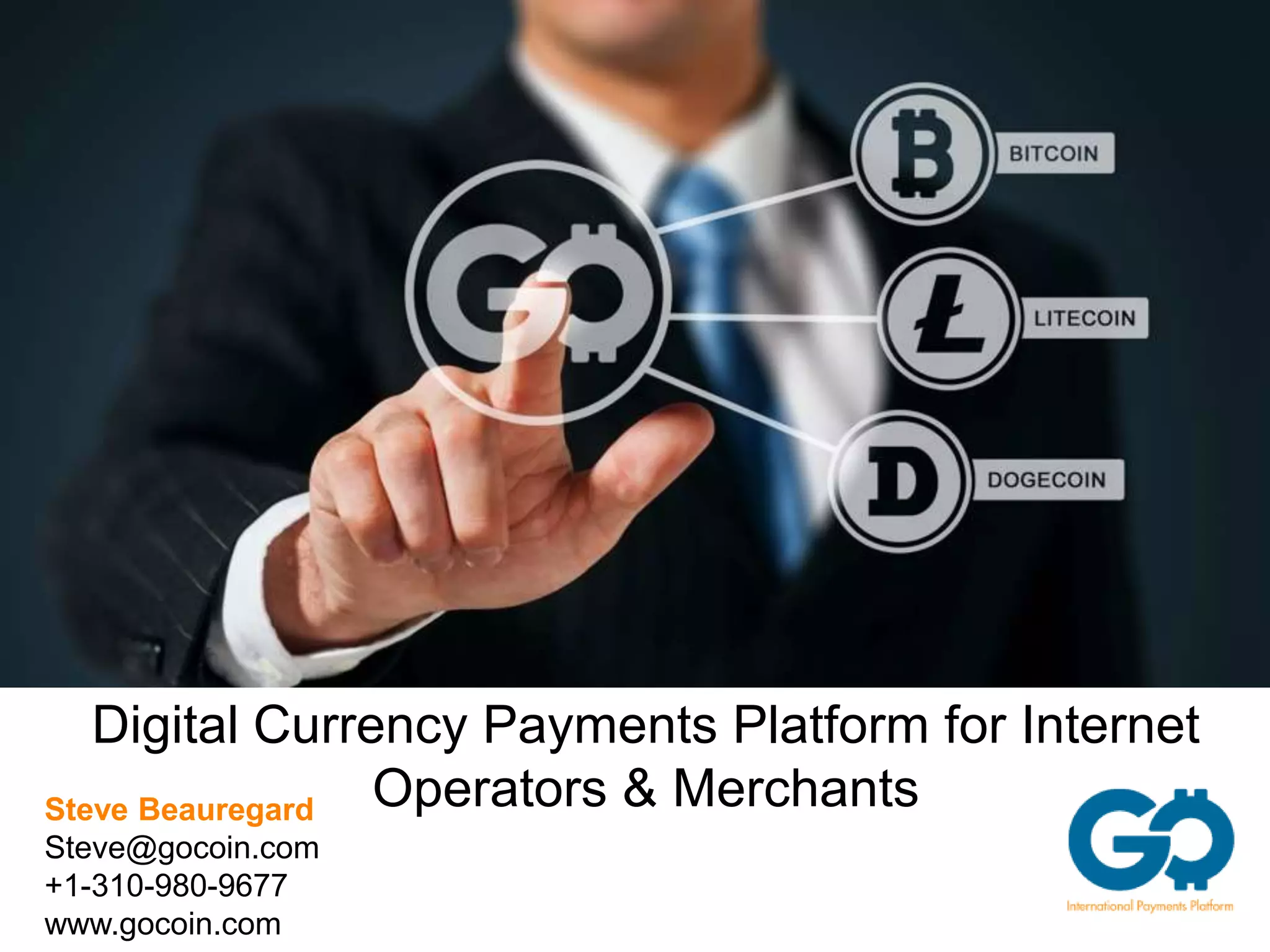
The cover slide establishes GoCoin as a "Digital Currency Payments Platform for Internet Operators & Merchants." The visual identity is built around a hand interacting with a digital interface that connects the GoCoin logo to Bitcoin, Litecoin, and Dogecoin. This immediately signals the company's core differentiator: multi-currency support. Contact information for CEO Steve Beauregard is prominently displayed, which is standard for the era. The subtitle "International Payments Platform" suggests a focus on cross-border utility, a common selling point for crypto in 2014.
Slide 2: The Transactional Flow
Titled "Coin to Cash Flow," this slide uses a nine-step diagram to explain the merchant experience. It starts with a customer checkout (1) and ends with a distribution of fiat to the merchant's bank account (9). Key technical details included here are the "Propriety GoCoin Exchnge" (note the typo in the slide) and the notification system. The bottom caption, "Cash to coin model opens added revenue stream," hints at a two-sided marketplace where GoCoin could potentially facilitate the purchase of crypto as well as the spending of it, though the diagram focuses strictly on the merchant payout side.
Slide 3: Market Alignment
Slide 3, "Alt-Coin Traders are Betting," provides a snapshot of the crypto market cap rankings. It lists Bitcoin at a price of $517.70 and a market cap of $6.8 billion. Notably, it highlights the 24-hour volume and percentage changes for assets like Ripple, BitShares, and Darkcoin. The strategic takeaway is at the bottom: "Profile of gamers lines up perfectly with coin traders." This indicates that GoCoin was not chasing the average retail shopper but was instead focusing on the high-velocity, tech-savvy gaming demographic that already held these assets.
Slide 4: Merchant Traction
This is a classic 'logo wall' slide titled "GoCoin Merchants Adding 100+ Weekly." The logos are diverse but lean heavily toward the 'grey market' and tech sectors. Featured merchants include eGifter, BitcoinShop.us, Apriva, KnCMiner, MindGeek, and Escrow.com. The claim of adding 100+ merchants weekly is a strong growth metric, though the slide does not distinguish between active merchants and those who have simply signed up for an account. The presence of MindGeek (the parent company of major adult sites) was a significant signal of GoCoin's willingness to handle high-risk verticals that traditional processors like PayPal often avoided.
Slide 5: The Technical Edge
Under the heading "2nd Movers Have Superior Tech," GoCoin lists eight bullet points describing their architecture. They emphasize being "Digital Currency Agnostic" and having a "scalable architecture." More specific technical claims include a "Full double entry accounting system" and "No hot-keys in the production environment," the latter being a security feature to prevent unauthorized access to funds. The slide explicitly states they launched "well after competition with full visibility to their weaknesses," a direct jab at early movers like BitPay or Coinbase who may have struggled with legacy code or Bitcoin-only limitations.
Slide 6: Fundraising and Use of Funds
This slide is unusually transparent regarding the company's capitalization table. It notes a Series A of $1.5M at an $11.5M post-money valuation in March 2014. It then states they are currently "Raising $1M Bridge Note (Today)" and planning a Series B of $10M-$15M for October or November of the same year. The "Use of funds" list is standard: global expansion, engineering depth, vertical solutions, and digital marketing. The bridge note request suggests the company was burning through its Series A capital quickly, likely due to the aggressive global expansion mentioned in point one.
Slide 7: Investor Pedigree
Titled "High Caliber Seed Investors," this slide serves as social proof. It features Owen Van Natta (Former COO of Facebook), Bill Lee (investor in Tesla and SpaceX), and institutional players like 500 Startups and Bitcoin Shop, Inc. The inclusion of Mikael Pawlo (CEO of Mr. Green) reinforces the company's focus on the online casino vertical. This slide is designed to de-risk the investment by showing that seasoned tech executives and specialized crypto funds have already performed due diligence.
Slide 8: Future Roadmap
The final slide in this set, "Future Services Competitive Advantage," outlines how GoCoin plans to expand beyond simple payment processing. The list includes digital currency payouts, KYC (Know Your Customer) retail coin sales, escrow services, and payroll/supply chain payments. The mention of "KYC Services (i.e. Experian for digital currency)" is particularly forward-thinking for 2014, suggesting GoCoin saw the coming wave of regulation and intended to build the infrastructure to manage it. This slide attempts to move the company's valuation from a simple 'payment processor' to a 'full-stack crypto financial services' provider.
What GoCoin Does Well
The GoCoin deck excels at market positioning . By 2014, Bitcoin-only processors were already becoming a commodity. GoCoin’s decision to lead with multi-currency support was a timely response to the rise of the first wave of altcoins. The deck also does an excellent job of identifying a specific niche (gamers and high-risk internet operators) rather than claiming they will replace all credit card transactions globally. This focus makes the merchant traction on slide 4 feel more credible.
Furthermore, the transparency regarding valuation and funding is refreshing. Most decks hide their previous valuation to avoid anchoring, but GoCoin uses its $11.5M post-money Series A as a floor to justify the bridge note and the upcoming larger Series B. This creates a sense of momentum and a clear financial trajectory for potential investors.
What is Missing from the Deck
The most glaring omission in the provided slides is a dedicated Team Slide . While investors are mentioned, the actual operators—aside from the CEO's contact info—are not profiled. In a technical field like crypto processing, the backgrounds of the CTO and the security team are paramount. Investors need to know who is building the "DDoS resistant architecture" mentioned on slide 5.
Additionally, the deck lacks Unit Economics . While it mentions adding 100 merchants a week, it does not disclose the average transaction volume (ATV), the take rate, or the churn rate of these merchants. Without these figures, it is impossible to determine if the $1.5M Series A was spent efficiently or if the business model is actually profitable at scale. The "Coin to Cash Flow" diagram explains the how , but not the how much .
Finally, there is no Competitor Matrix . While the deck alludes to "first movers" and their weaknesses, it does not name them or provide a feature-by-feature comparison. A slide comparing GoCoin to BitPay, Coinbase, and perhaps traditional processors like Neteller would have strengthened the "Second Mover" argument.
Founder's Guide: What to Copy
The 'Second Mover' Narrative: If you are entering a crowded market, do not ignore the incumbents. Use GoCoin’s strategy of explicitly stating that you have studied their weaknesses and built a 'Version 2.0' that addresses them. This turns a lack of early market share into a technical and strategic advantage.
Vertical Specificity: GoCoin didn't just say "merchants"; they said "Internet Operators" and linked them to "gamers." When pitching, identify the specific sub-sector where your product has the highest resonance. A logo wall full of companies in the same vertical is more convincing than a random assortment of unrelated businesses.
Clear Funding Roadmap: Even if you don't disclose your valuation, providing a clear timeline of your past rounds and your future needs (as seen on slide 6) helps investors understand where they fit into your capital structure. It shows you are thinking about the long-term capitalization of the company, not just the next six months.
Proprietary Infrastructure: Highlighting that you own a key part of the value chain—in this case, the "Propriety GoCoin Exchange"—is a strong moat. It suggests that you aren't just a wrapper around someone else's API, but that you have deep integration that competitors cannot easily replicate.
Frequently asked questions
- What was GoCoin's primary value proposition in 2014?
- GoCoin positioned itself as a 'Digital Currency Agnostic' payment platform. Unlike early competitors who focused exclusively on Bitcoin, GoCoin integrated Litecoin and Dogecoin. They targeted 'Internet Operators & Merchants' who wanted to accept multiple digital currencies without managing the volatility, as GoCoin handled the conversion to fiat currency through their proprietary exchange.
- How did GoCoin justify being a 'second mover' in the crypto space?
- On slide 5, the company explicitly claims that being a second mover allowed them to build 'superior tech' with full visibility into the weaknesses of first-generation platforms. They cited features like a full double-entry accounting system, a RESTful API separated from the dashboard, and a DDoS-resistant architecture as technical advantages gained by launching later.
- What were the specific financial terms of GoCoin's previous funding rounds?
- Slide 6 provides rare transparency for a pitch deck. It states that GoCoin raised a $1.5M Series A in March 2014 at an $11.5M post-money valuation. At the time of the deck (August 2014), they were raising a $1M bridge note to sustain operations until a projected $10M-$15M Series B in October or November.
- Which industries was GoCoin targeting for merchant adoption?
- The deck highlights a specific alignment between 'coin traders' and 'gamers' on slide 3. Their merchant logo wall on slide 4 confirms this focus, featuring companies like Mr. Green (online casino), MindGeek, and various hardware/mining companies like KnCMiner and GAWMiners, alongside general e-commerce like eGifter.
- Who were the key investors backing GoCoin at this stage?
- The 'High Caliber Seed Investors' slide (slide 7) lists Owen Van Natta (former Facebook COO), Bill Lee (angel investor in Tesla and SpaceX), Crypto Currency Partners, Bitcoin Shop, Inc. (OTC: BTCS), Mikael Pawlo (CEO of Mr. Green), and the accelerator 500 Startups.