300 Milligrams utilized a high-contrast, minimalist deck for their Demo Day presentation, focusing on the visual problem of 'tab fatigue' across various SaaS platforms like Gmail, Dropbox, and Salesforce. The deck relies heavily on screenshots to demonstrate a unified dashboard that aggregates tasks and documents from disparate services. With a stated user base of over 1,000 and a viral referral rate of 16%, the company projects a $6 billion market opportunity based on a $10 monthly subscription model. While the deck excels at communicating a simple product vision, it lacks traditional deep d…
Key takeaways
- The deck uses a bold hook on Slide 1, describing the vision as 'If Zuckerberg Built SAP.'
- Visual evidence of the problem is shown through fragmented screenshots of six different SaaS platforms on Slide 3.
- The product solution is a unified dashboard that aggregates 'Pitching notes' and 'Demo day pitch scripts' in one view (Slide 4).
- The platform already supports 11 integrations including GitHub, Basecamp, and Salesforce, with 8 more 'Coming Soon' (Slide 5).
- Traction is quantified at 1,000+ users with a 16% referral rate leading to 20,000 collaborators (Slide 7).
- The system has already indexed 3,500,000 documents and tasks according to Slide 7.
- Market size is calculated using a simple formula: 50M+ addressable users at $10/month equals a $6B opportunity (Slide 8).
- The deck omits a dedicated team slide, detailed financial projections, and a specific funding 'ask' amount.
The Minimalist Demo Day Strategy
The 300 Milligrams deck is a classic example of a 'stage deck.' It is designed to be a visual aid for a live speaker rather than a leave-behind document. With very few words per slide and large, high-contrast imagery, it forces the audience to focus on the presenter's narrative while providing immediate visual proof of the product's utility. The primary theme is the simplification of the modern 'work graph.'
Slide 1: The Hook
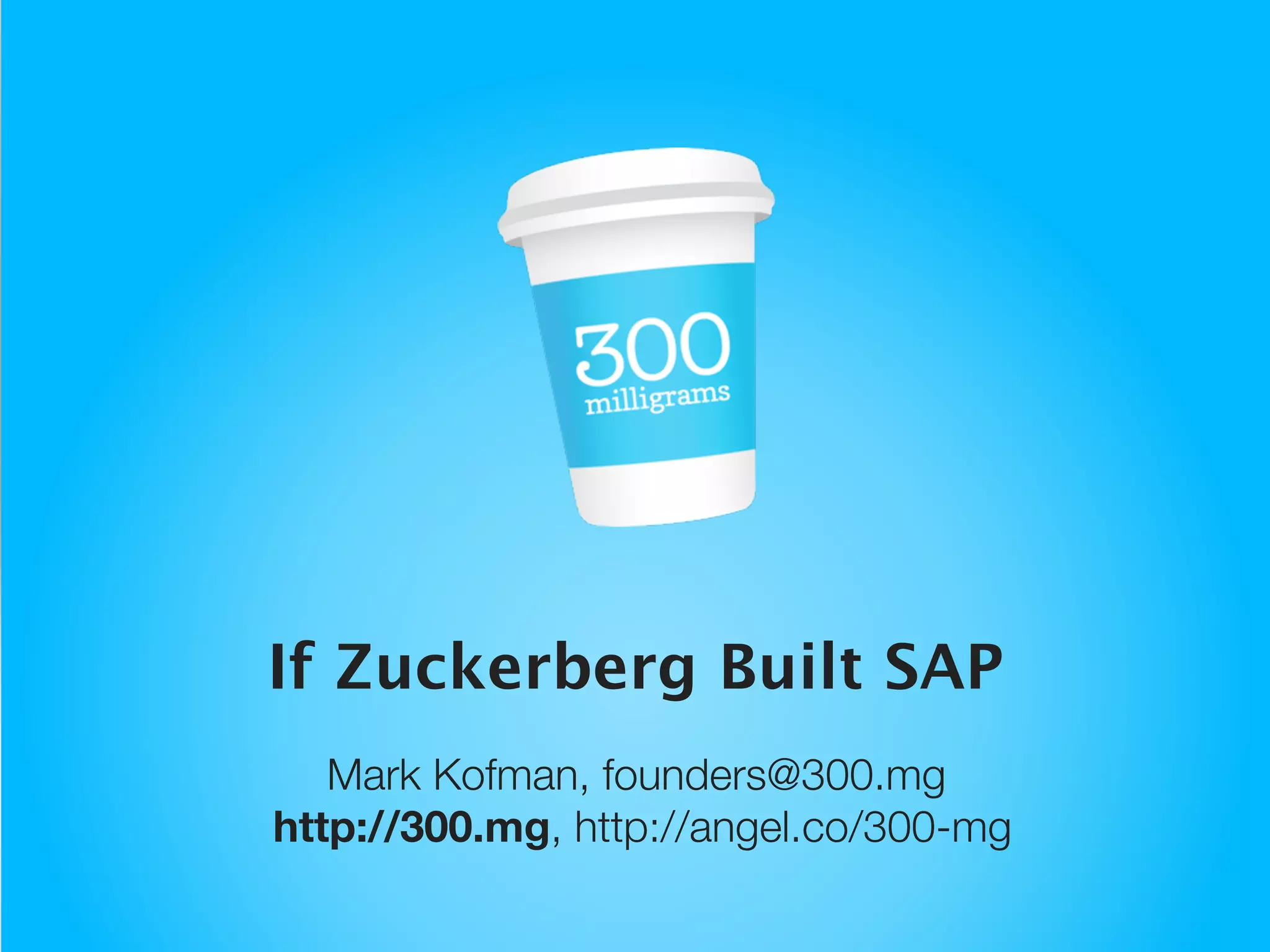
The title slide features the company logo—a stylized coffee cup—and a provocative sub-headline: "If Zuckerberg Built SAP." This is a high-concept pitch designed to immediately signal that the company is taking the 'social' and 'user-friendly' design language of Facebook and applying it to the traditionally clunky world of Enterprise Resource Planning (ERP) and business software. It includes contact info for Mark Kofman and links to their AngelList profile.
Slides 2-3: The Visual Problem Statement
Slide 2 and Slide 3 function as a 'before' picture. They show a series of small, cluttered screenshots of Gmail, Google Calendar, Basecamp, Google Docs, Dropbox, and Salesforce. The lack of text on these slides suggests the presenter is likely describing the pain of 'tab fatigue'—the cognitive load required to manage work across half a dozen different platforms. By showing these logos and interfaces together, the deck establishes the fragmented reality of the modern knowledge worker.
Slide 4: The Solution (Unified Dashboard)
Slide 4 introduces the 300 Milligrams interface under the header "All Work On One Dashboard." The screenshot shows a clean, vertical feed of activity. It lists specific items like 'Pitching notes' from Evernote, 'Demo day pitch script' from Google Docs, and 'Start Fund' from Salesforce. This slide is the 'aha moment,' showing how the product pulls disparate data into a single, chronological, or priority-based list.
Slide 5: Integration Ecosystem
To prove the product is functional and not just a mockup, Slide 5 displays the current and future integration library. The top row shows 11 active integrations, including Google Docs, Dropbox, Backpack, Basecamp, Highrise, Pivotal Tracker, Box, GitHub, Google Calendar, Salesforce, and AngelList. Below this, the slide promises "Coming Soon: 2 Days Per Service," listing 8 additional heavy hitters like Gmail, Evernote, and Trello. The '2 days per service' claim is a bold statement about the efficiency of their underlying integration architecture.
Slides 6-7: Traction and Virality
Slide 6 starts with a simple "1,000+ USERS" metric. Slide 7 expands on this with deeper engagement data. It claims that "16% REFER TO 20,000 COLLABORATORS." This is a crucial data point for investors because it suggests a built-in viral loop; as users use the tool to manage projects, they naturally pull their colleagues into the ecosystem. The slide also mentions "3,500,000 DOCS, TASKS,..." which indicates the platform is successfully indexing and processing a high volume of data, proving technical scalability.
Slide 8: Market Opportunity
The deck uses a 'bottom-up' market sizing approach on Slide 8. It avoids vague 'TAM' (Total Addressable Market) figures from Gartner or Forrester and instead uses a simple math equation: 50M+ Addressable Users x $10 Month = $6B. This tells the investor exactly how the company views its pricing power and its target demographic. It assumes a massive market of knowledge workers willing to pay a premium for productivity gains.
Slide 9: Conclusion
The final slide returns to the coffee cup branding with a simple "Thank You!" and repeats the contact information. It maintains the minimalist aesthetic, ensuring the last thing the audience sees is the brand and the way to get in touch.
What Works in This Deck
Visual Clarity: The deck is remarkably uncluttered. By using large screenshots and minimal text, the founders ensure that the audience isn't distracted by reading long bullet points while they are speaking. This is the gold standard for Demo Day presentations.
The 'Zuckerberg' Hook: Comparing the product to a well-known entity (Facebook/Zuckerberg) and a well-known problem (SAP/Enterprise software) creates an instant mental model for the investor. It defines the category and the design philosophy in four words.
Proof of Velocity: Stating that new integrations take only '2 days' to build is a powerful way to demonstrate technical superiority without showing a single line of code. It suggests a robust, modular backend that can scale as fast as the SaaS market grows.
What Is Missing
The Team: There is no slide dedicated to the founders' backgrounds. While Mark Kofman is named on the title slide, investors have no idea if the team has the enterprise or engineering pedigree to pull off a 'social SAP.'
Competitive Landscape: The deck ignores competitors like Zapier, IFTTT, or other dashboard aggregators (e.g., Netvibes for enterprise). Investors would likely want to know how 300 Milligrams stays ahead of the platforms themselves (like Salesforce) building their own aggregation layers.
Business Model Depth: While the $10/month figure is provided, there is no mention of Customer Acquisition Cost (CAC) or Lifetime Value (LTV). Given the 16% referral rate, the 'Organic vs. Paid' acquisition mix is a missed opportunity for a deeper traction story.
Founder's Guide: What to Copy
The 'Problem' Slide Layout: Slide 3 is an excellent way to show a 'messy' problem without using a single word. If your startup solves fragmentation, showing the logos of the fragmented services in a jumbled way is a highly effective visual shorthand.
Simple Math for Market Size: Avoid the 'Trillion Dollar Market' trap. Copy the Slide 8 approach: [Target Users] x [Price Point] = [Opportunity]. It is defensible and easy to remember.
Integration Transparency: If your product relies on an ecosystem, clearly separating what is 'Live' versus what is 'Coming Soon' (as seen on Slide 5) builds credibility. It shows you have a roadmap and the capability to execute against it.
Frequently asked questions
- What is the core product of 300 Milligrams?
- Based on Slide 4 and Slide 5, 300 Milligrams is a productivity dashboard that aggregates data from multiple third-party SaaS applications. It allows users to see tasks, documents, and updates from services like Google Docs, Dropbox, Basecamp, and Salesforce in a single, unified feed, aiming to reduce the need to switch between multiple browser tabs.
- How does the company plan to make money?
- Slide 8 explicitly outlines a subscription-based revenue model. The company targets a price point of $10 per month per user. By multiplying this by an estimated 50 million addressable users, they project a total market opportunity of $6 billion, though the deck does not specify the timeline for reaching this scale.
- What kind of traction did 300 Milligrams have at the time of this deck?
- Slide 7 reports that the platform had surpassed 1,000 users. More significantly, it highlights a viral growth mechanism where 16% of users refer the service to others, resulting in a network of 20,000 collaborators. The platform had also processed a significant volume of data, citing 3,500,000 documents and tasks indexed.
- Which integrations does the platform currently support?
- According to Slide 5, the platform supports Google Docs, Dropbox, Backpack, Basecamp, Highrise, Pivotal Tracker, Box, GitHub, Google Calendar, Salesforce, and AngelList. The slide also lists upcoming integrations for Gmail, Evernote, Zendesk, Confluence, Asana, Google Sites, Trello, and SugarCRM.
- What is missing from this pitch deck?
- This is a minimalist Demo Day deck, so it omits several standard components. There is no team slide detailing founder experience, no competitive analysis against other aggregators, no breakdown of operating expenses, and no specific 'ask' regarding the amount of capital they are looking to raise or the valuation sought.