AGV Protocol is a decentralized platform designed to tokenize real-world assets (RWA), specifically targeting solar power, agricultural orchards, and edge compute infrastructure. The deck positions the company at the intersection of the AI power demand crisis and the emerging liquid financing layer of crypto-integrated IPOs. With a dual-token model (rGGP and GVT) and a 'Power-to-Mint' mechanism verified by IoT, the protocol aims to deliver internal rates of return (IRR) between 18-26%. The business model relies on recurring yield fees, NFT sales, and compute service revenue. While the deck pr…
Key takeaways
- The protocol targets a global bottleneck in power and compute infrastructure, citing AI demand as a primary driver for RWA growth (Slide 2).
- AGV Protocol utilizes a dual-token model where rGGP provides adoption incentives and GVT serves as the governance and utility token (Slide 4).
- The 'Power-to-Mint' mechanism ensures tokens are only minted after IoT verification of physical energy output (Slide 4).
- Phase 1 cash flow projections estimate $0.52M in annual net cash flow from solar, orchards, and compute assets (Slide 6).
- The company claims pilot revenues have already been realized and audited by certified accountants (Slide 6).
- Tokenomics are divided into five categories, with the largest portion (30%) allocated to the community (Slide 8).
- Smart contracts were audited by Beosin in August 2025, and the protocol has achieved 7,800+ TaskOn participants (Slide 8).
- Valuation is tied to asset expansion milestones, targeting an $80-100M FDV in Phase 1 and $200M FDV by Phase 3 (Slide 12).
Executive Summary: The RWA Pivot to Infrastructure
AGV Protocol presents itself as a solution to the 'Global Dilemma' of infrastructure strain caused by the AI boom. The deck, labeled as a 'BD Version' dated September 2025, focuses heavily on the financialization of energy and compute assets. It attempts to move beyond the speculative nature of early DeFi by anchoring token value in audited, real-world cash flows. The narrative is built on the premise that traditional IPOs are too slow and exclusive, positioning tokenized Real-World Assets (RWA) as the next logical step for global capital markets.
Slide 1: Title and Positioning
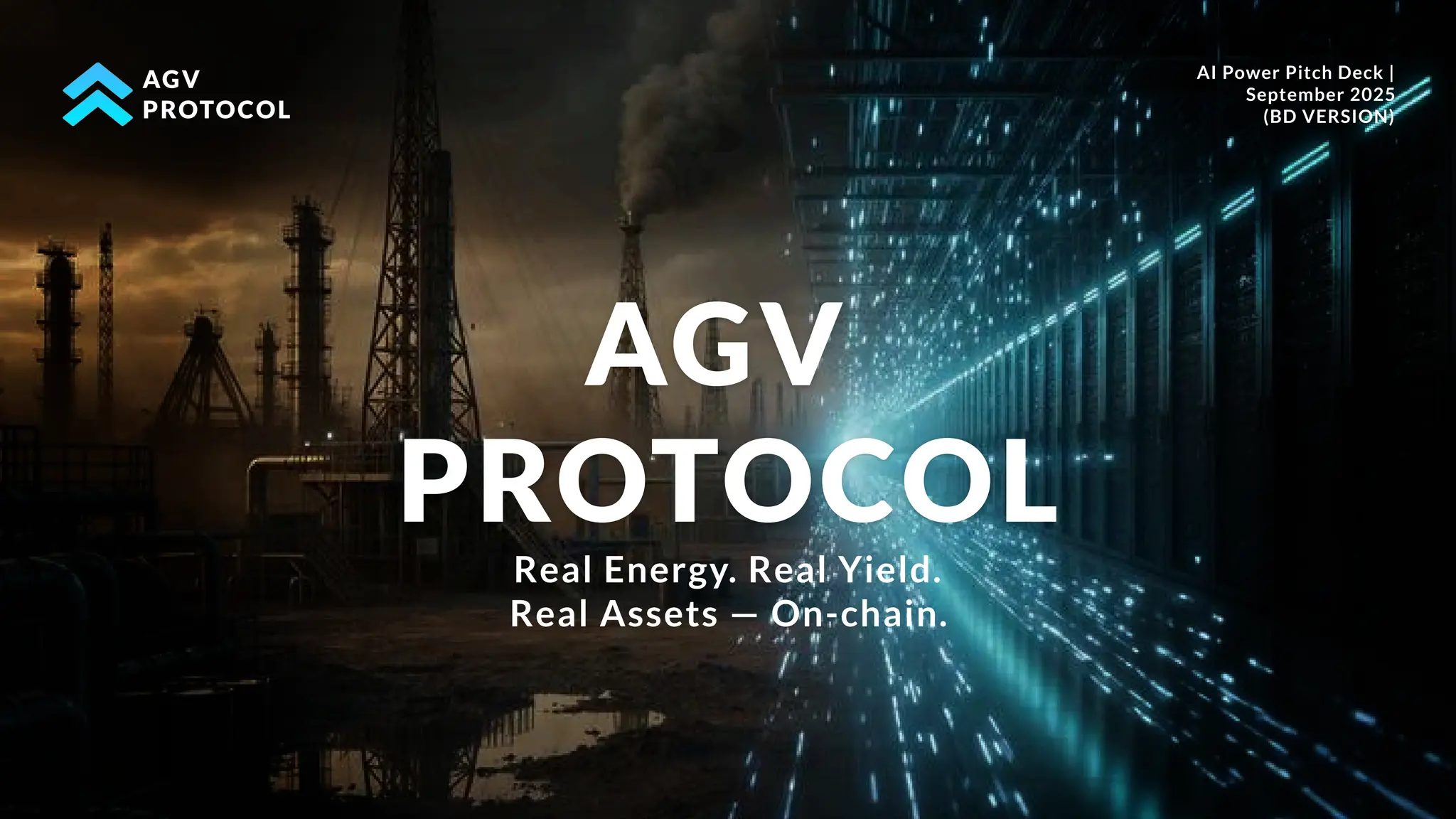
The cover slide establishes the core value proposition: 'Real Energy. Real Yield. Real Assets — On-chain.' It uses industrial imagery (oil rigs and server rooms) to contrast physical infrastructure with digital speed. Notably, the slide is dated September 2025, suggesting this is either a forward-looking projection or a very recent document. The 'BD Version' tag indicates this deck is likely intended for business development or strategic partnerships rather than a pure venture capital pitch.
Slide 2: The Global Dilemma and Market Opportunity
This slide identifies a 'Universal Bottleneck' in grids, cooling systems, and compute infrastructure across the U.S., Europe, and Asia. It frames RWA + Crypto as the 'Next IPO Market,' comparing traditional IPOs (slow, national, exclusive) against RWA IPOs (fast, global, inclusive). The slide leverages institutional credibility by mentioning BlackRock, Goldman Sachs, and Hong Kong as early adopters of the RWA narrative. The map highlights key regions of interest, though it does not specify if these are active project sites or target markets.
Slide 4: Product Architecture and Yield Mechanics
AGV Protocol breaks its product suite into four 'NFT Passes': TreePass (orchards), SeedPass (ecosystem access), SolarPass (solar farms), and ComputePass (edge compute). The slide introduces a dual-token model: rGGP for incentives and yield, and GVT for governance and utility. A critical technical claim is the 'Power-to-Mint' mechanism, which uses IoT verification to link digital tokens to physical energy output. The slide targets an IRR of 18-26%, positioning it as a high-yield alternative to traditional renewable energy funds.
Slide 6: Business Model and Financial Projections
The business model is diversified across four revenue streams: recurring yield fees, NFT sales, compute services, and a token economy (buybacks). The 'Phase 1 Cashflow Projection' table provides specific figures:
Solar (6MWp): ~$438K revenue / $318K net. · Orchards (100 MU): ~$55K revenue / $35K net. · Compute (1.5MW): ~$225K revenue / $165K net.
The total net cash flow is projected at ~$0.52M annually. A significant claim at the bottom of the slide states that pilot revenues have already been realized and audited by certified accountants, which serves to de-risk the projections for potential partners.
Slide 8: Tokenomics and Community Traction
The token allocation is clearly defined: 30% Community, 20% Ecosystem Development, 20% Private & Public Sales, 15% Team & Advisors, and 15% Treasury/DAO. Traction metrics include 7,800+ TaskOn participants and an audit by Beosin completed in August 2025. The slide also mentions 'KOL clusters' formed via the G3 Fund, suggesting a marketing strategy heavily reliant on crypto-native influencers. The presence of NFTs on BSC, Polygon, and Arbitrum indicates a multi-chain deployment strategy.
Slide 10: Team Execution Strength
The team slide lists eight members with specific functional roles. Susan Zheng (Strategy) and Lynn Wang (Institutional Capital) bring 'Ex-IB' and 'Ex-Quant' backgrounds, respectively. The technical side is represented by Tyler (Compliance), Yasir (Smart Contracts), Robin Wu (Front-End), and Phantom (Security). Winnie Wu and Yatogami handle partnerships and business development. While the roles are clear, the slide lacks specific previous company names (e.g., which investment bank or quant firm), which is a common omission in crypto-focused decks.
Slide 12: Milestone-Based Valuation Drivers
This slide provides a roadmap for valuation growth tied to physical asset acquisition:
Phase 1: 6MWp solar + 1.5MW compute cluster = $80-100M FDV. · Phase 2: 10+ asset units = $120-150M FDV. · Phase 3: 50+ assets and cross-chain RWA = $200M FDV.
By explicitly linking valuation to 'real asset expansion, not just narrative,' the protocol attempts to provide a more traditional fundamental analysis framework for its token price.
What Works in This Deck
Tangible Unit Economics: Slide 6 is the strongest part of the deck. By breaking down revenue and net income by asset type (Solar vs. Compute), the founders show they understand the underlying costs of the physical businesses they are tokenizing. The claim of audited pilot revenues adds significant weight to these numbers.
Verification Logic: The 'Power-to-Mint' concept on Slide 4 addresses the biggest skepticism in RWA: how do we know the asset exists and is performing? Using IoT as a gatekeeper for token issuance is a strong technical narrative that appeals to both crypto-native and traditional investors.
Valuation Transparency: Slide 12 is unusual for a crypto deck. Most projects avoid stating a target FDV (Fully Diluted Valuation) so explicitly. By tying these numbers to specific asset milestones (e.g., 6MWp of solar), the team creates a clear 'if-then' proposition for investors.
What Is Missing or Weak
The 'Ask': The provided slides do not include a specific funding request. We do not know how much capital they are raising, the terms of the round, or the specific use of proceeds. While this is a 'BD Version,' a fundraising analyst needs to see the capital requirements to scale to the Phase 1 targets.
Competitive Landscape: The RWA space is crowded with players like Centrifuge, Goldfinch, and various energy-specific protocols. The deck fails to mention any competitors or explain why AGV’s specific mix of solar, orchards, and compute is superior to existing solutions.
Regulatory Detail: Tokenizing real-world assets involves complex legal structures, especially when offering 'yield' and 'fractional ownership.' Slide 10 mentions a 'compliance framework,' but there is no detail on the legal jurisdictions, SPV structures, or how they handle securities laws in the regions they operate (U.S., Europe, Asia).
Founder's Playbook: What to Copy
Asset-Linked Roadmaps: Instead of a roadmap based on 'Mainnet Launch' or 'Exchange Listing,' copy AGV’s approach on Slide 12. Link your company's value to physical milestones or revenue targets. It makes the growth story feel inevitable rather than speculative.
Revenue-First Narrative: Slide 6 proves that the project isn't just a whitepaper. Even if your pilot is small, showing that you have 'audited pilot revenues' changes the conversation from 'what if' to 'how fast can we scale.'
Hybrid Imagery: The visual language of the deck (Slide 1 and 2) successfully bridges two worlds. It uses high-tech digital aesthetics alongside gritty, industrial photography. This is an effective way to signal to investors that you are comfortable in both the server room and the boardroom.
Frequently asked questions
- What specific assets does AGV Protocol tokenize?
- According to Slide 4, the protocol tokenizes three primary asset classes: solar energy farms (SolarPass), fractional orchard ownership (TreePass), and edge compute clusters (ComputePass). These are represented as asset-backed NFTs and tokens, with a fourth category, SeedPass, providing early ecosystem access.
- How does the protocol verify the existence of the real-world assets?
- The deck introduces a 'Power-to-Mint' mechanism on Slide 4. This system requires IoT (Internet of Things) verification of physical output—specifically real electricity—before digital tokens are minted, creating a direct audit trail between the physical asset and the blockchain.
- What are the projected returns for investors?
- Slide 4 and Slide 6 both state a targeted Internal Rate of Return (IRR) of 18-26%. The deck claims this is significantly above traditional renewable funds and is backed by real-world cash flows from energy production and compute rentals.
- What is the current traction of the project?
- Slide 8 highlights several traction metrics: over 7,800 TaskOn participants, robust KOL (Key Opinion Leader) clusters via the G3 Fund, and active communities across multiple regions. Additionally, smart contracts were audited by Beosin in August 2025.
- How is the team structured?
- Slide 10 outlines an eight-person leadership team covering Strategy & Capital Markets (Susan Zheng), Tech & Compliance (Tyler), Institutional Capital (Lynn Wang), Strategic Partnerships (Winnie Wu), Smart Contracts (Yasir), Front-End (Robin Wu), Security (Phantom), and BD (Yatogami).