Daseke Inc.'s 2017 investor presentation outlines a clear and aggressive strategy for consolidating the highly fragmented North American open deck transportation and logistics market. The deck emphasizes a track record of significant growth, moving from $30 million in revenue in 2009 to a pro forma $770 million in 2016, representing a 59% CAGR. By focusing on specialized services like flatbed, step deck, and super heavy haul, Daseke has secured long-term relationships with blue-chip industrial giants such as Boeing, Caterpillar, and GE. The presentation effectively utilizes financial metrics,…
Key takeaways
- Daseke achieved a 59% revenue CAGR from 2009 to 2016, reaching a pro forma $770 million (Slide 4).
- Pro forma Adjusted EBITDA grew at a 48% CAGR, hitting $101 million by 2016 (Slide 4).
- The company specializes in diverse open deck services, including Flatbed, Step Deck, and Super Heavy Haul (Slide 6).
- Daseke maintains a blue-chip customer base where no single client exceeds 8% of total revenue (Slide 8).
- Top 10 customer relationships average over 20 years, indicating high retention and stability (Slide 8).
- Approximately 95% of customer relationships are direct, reducing reliance on third-party brokers (Slide 8).
- The deck projects 2017 targets of $979 million in revenue and $140 million in Adjusted EBITDA (Slide 14).
- A structured earnout for management aligns with share price targets reaching $16.00 by 2019 (Slide 16).
Daseke Inc.: A Masterclass in Industrial Consolidation
The 2017 investor presentation for Daseke Inc. serves as a strategic roadmap for how a specialized logistics provider can dominate a fragmented market through disciplined acquisitions and operational excellence. By focusing on the "open deck" niche—transporting goods that don't fit in a standard box trailer—Daseke positioned itself as an essential partner for heavy industry. This teardown explores how the company communicated its value proposition to investors during a pivotal growth phase.
Slide 1-2: The Vision and the Visuals
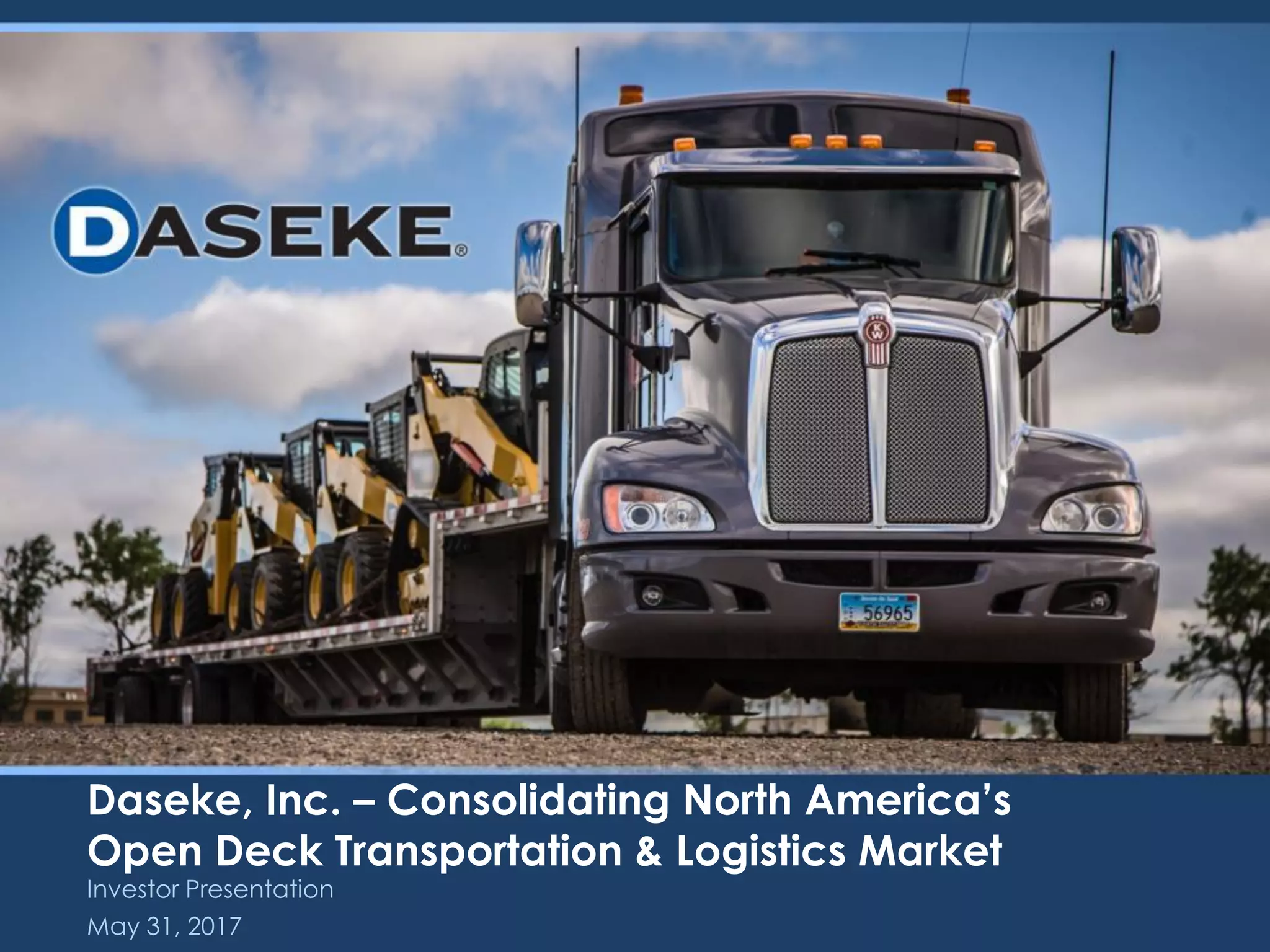
The presentation opens with high-impact imagery of heavy-duty Kenworth trucks transporting industrial equipment. The title, "Consolidating North America’s Open Deck Transportation & Logistics Market," immediately establishes the company's core mission. Slide 2 reinforces this with a photo of an "Oversize Load" being moved through a construction site, visually defining the specialized nature of their work. There is no ambiguity here; Daseke is telling the investor exactly what they do and what their goal is within the first two seconds.
Slide 4: The Growth Engine
Slide 4 is perhaps the most critical slide for any growth-oriented investor. It displays two massive bar charts showing "Pro Forma Revenue Growth" and "Pro Forma Adjusted EBITDA Growth." The figures are staggering: revenue grew from $30 million in 2009 to a pro forma $770 million in 2016, a 59% CAGR. Similarly, Adjusted EBITDA climbed from $6 million to $101 million, a 48% CAGR. The use of "Pro Forma" is important here, as it includes the impact of recent acquisitions, highlighting the success of their consolidation strategy. The footnotes provide necessary transparency, detailing how these figures were calculated and what adjustments were made to reach the $101 million EBITDA mark.
Slide 6: Defining the Niche
To the uninitiated, "trucking" is a commodity business. Slide 6, titled "What is Open Deck," dispels this notion by showcasing the complexity of Daseke's operations. Through six photos, they illustrate their capabilities: Flatbed, Step Deck, Over Dimensional, Super Heavy Haul, High Value Customized, and RGN (Removable Gooseneck). By showing a wind turbine blade and a shrink-wrapped aircraft, Daseke demonstrates that they handle cargo requiring specialized equipment and expertise, which typically commands higher margins and creates higher barriers to entry than standard dry van shipping.
Slide 8: The Strength of the Customer Base
Slide 8 addresses the risk of customer concentration and the quality of the revenue stream. The pie chart shows that while the top 10 customers account for 36% of revenue, no single customer accounts for more than 8%. This is a healthy balance for an industrial service provider. The list of "Top Customers" is a "who's who" of American industry: Boeing, Caterpillar, GE, Nucor, and Vestas, among others. Most impressively, the slide notes that approximately 95% of these are direct customer relationships, and the top 10 relationships average over 20 years. This suggests deep integration into the supply chains of their clients, making Daseke a sticky, long-term partner rather than a replaceable vendor.
Slide 10: Market Dynamics
Slide 10, "Improving Industry Environment," uses a complex line graph from Morgan Stanley Research to show "Incremental Demand / Incremental Supply" dynamics from 2006 to 2017. The 2017 line (in red) shows a significant upward trend compared to previous years and the 10-year average. This slide is intended to show that Daseke is not just growing through its own efforts, but is also benefiting from a favorable macro tailwind in the logistics sector. It provides external validation for the company's aggressive expansion timing.
Slide 12-14: The Financial Deep Dive
After the "Appendix" transition on Slide 12, Slide 14 provides a multi-year look at key metrics. It shows a clear trajectory for Revenue, Adjusted EBITDA, and Free Cash Flow from 2013 through a projected 2017. The 2017 targets are ambitious: $979 million in revenue and $140 million in Adjusted EBITDA. Interestingly, the slide also tracks "Net Capital Expenditures as a % of Revenue," which shows a downward trend from 13% in 2014 to a projected 7% in 2017. This indicates that as the company scales, it is becoming more capital-efficient, a key metric for sustaining long-term profitability in a capital-intensive industry.
Slide 16: Alignment of Interests
The final substantive slide in this selection, Slide 16, details the "Earnout Structure." This is a sophisticated way to show investors that management is "fully aligned" with public stockholders. The table outlines stock awards of up to 5 million shares per year from 2017 to 2019, contingent on hitting both Adjusted EBITDA targets (rising to $200 million) and stock price targets (rising to $16.00). By tying management's compensation to these specific, public milestones, Daseke provides a clear incentive for leadership to execute the strategy laid out in the preceding slides.
What Works in the Daseke Deck
Clear Niche Identification: Daseke does an excellent job of separating itself from the general trucking market. By emphasizing "Open Deck" and showing the specialized equipment required, they justify their market position and potential for higher margins.
Aggressive Growth Metrics: The use of CAGR (Compound Annual Growth Rate) on Slide 4 is highly effective. Moving from $30M to $770M in seven years is a powerful narrative of successful execution.
Blue-Chip Validation: Listing logos like Boeing and GE isn't just for show; the accompanying data about 20-year average relationships proves that these aren't just one-off contracts, but a stable foundation for the business.
Transparency in Incentives: The earnout slide is a bold inclusion. It tells investors exactly what management needs to achieve to get paid, providing a level of transparency that builds trust.
What is Missing from the Daseke Deck
Competitive Landscape: While the deck mentions consolidating a fragmented market, it doesn't explicitly name competitors or show a market share breakdown. Investors would benefit from seeing who else is in the space and why Daseke is the preferred acquirer.
Acquisition Pipeline Details: Since consolidation is the core strategy, a slide detailing the number of potential targets in the pipeline or the typical multiples paid for acquisitions would provide more color on how they plan to reach their $1B+ revenue targets.
Technology and Efficiency: In modern logistics, technology is a major differentiator. The deck is light on how Daseke uses software, telematics, or data analytics to optimize its fleet and improve margins beyond just buying more trucks.
Team Slide: The provided selection lacks a team slide. For a company built on a roll-up strategy, the experience of the M&A team and the operational leadership is paramount.
What Founders Should Copy
Visual Proof of Service: If your business involves physical operations, use high-quality photos to show exactly what you do. Daseke's "What is Open Deck" slide is a perfect example of using visuals to explain a complex service quickly.
Focus on Direct Relationships: Highlighting that 95% of their business is direct rather than through brokers is a strong signal of business health. Founders should always emphasize the directness and longevity of their customer relationships.
Pro Forma Clarity: When growing through acquisitions, using pro forma numbers is necessary, but always include the detailed footnotes as Daseke did on Slide 4. It shows you aren't trying to hide the math.
Alignment Slides: If you have a performance-based compensation structure or specific milestones tied to equity, don't be afraid to show them. It demonstrates confidence in your ability to hit your targets.
Conclusion
The Daseke Inc. deck is a textbook example of a "roll-up" story. It focuses on a specific, defensible niche, demonstrates a proven track record of growth, and shows a clear path to future value through management alignment. While it leans heavily on the physical assets and financial results, it successfully paints a picture of a company that is the undisputed leader in a specialized and essential corner of the North American economy.
Frequently asked questions
- What is Daseke's primary business strategy?
- Daseke's primary strategy is the consolidation of the North American open deck transportation and logistics market. They focus on acquiring specialized carriers to build a comprehensive network capable of handling complex, over-dimensional, and high-value freight that standard van carriers cannot accommodate.
- How has Daseke performed financially leading up to this presentation?
- The company demonstrated explosive growth between 2009 and 2016. Revenue grew from $30 million to a pro forma $770 million, while Adjusted EBITDA rose from $6 million to $101 million. This represents a 59% revenue CAGR and a 48% EBITDA CAGR over that seven-year period.
- Who are Daseke's major customers?
- Daseke serves a blue-chip industrial base, including global leaders like Boeing, Caterpillar, GE, Georgia-Pacific, and Nucor. Their top 10 customers have an average relationship length of over 20 years, and the revenue stream is well-diversified, with no single customer representing more than 8% of total sales.
- What specialized services does Daseke offer?
- Daseke provides a variety of open deck services tailored for non-standard cargo. These include flatbed, step deck, over-dimensional, super heavy haul, high-value customized transport, and Removable Gooseneck (RGN) trailers, allowing them to move everything from wind turbine blades to aircraft components.
- How is management incentivized in this deck?
- The deck details a unique earnout structure for pre-SPAC merger stockholders and management. They are eligible for up to 15 million shares of common stock based on hitting specific annualized Adjusted EBITDA targets (up to $200 million) and share price targets (up to $16.00) through the year 2019.