ProSmart (TSX-V:PROS) presented this deck in June 2018 to detail the value proposition of Sportgo, its digital platform for the sports industry. The company targets a $1.3 trillion market, citing the decline of traditional TV viewership and the fragmentation of online sports content as key drivers. The deck emphasizes four pillars: Educate, Equip, Build Community, and Build Marketplace. A significant portion of the strategy focuses on the Chinese market, leveraging the 2022 Beijing Winter Olympics and the acquisition of DL Hockey to integrate with WeChat. Notably, the deck lacks specific curr…
Key takeaways
- The company identifies a $1.3 trillion global sports market with over 1 billion youth and recreational players (Slide 5).
- Sportgo is positioned as a 'gateway' and a dedicated community of interest, contrasting itself with general social networks like Facebook and Instagram (Slide 1 and 9).
- The business model relies on four pillars: Educate (coaching), Equip (administration), Community (network), and Marketplace (sponsorships) (Slide 7).
- China is a primary growth target, with plans to integrate with WeChat and capitalize on a mandated $3.9 billion spend on the 2022 Winter Olympics (Slide 11).
- ProSmart acquired DL (Doug Lynch) Hockey to establish a physical presence in China through hockey clubs and skills camps (Slide 11).
- The deck uses a theoretical valuation matrix rather than reporting actual current performance metrics (Slide 13).
- The presentation omits a traditional team slide, detailed financial history, and a specific capital 'ask' or use of proceeds (Slides 1-13).
Executive Summary: The Sportgo Vision
The ProSmart investor presentation from June 2018 serves as a strategic roadmap for Sportgo, a platform designed to consolidate the fragmented digital sports landscape. Listed on the TSX Venture Exchange under the symbol PROS, the company positions itself not just as a social network, but as a comprehensive ecosystem for the $1.3 trillion global sports market. The deck focuses heavily on market macro-trends and a specific expansion into China, while remaining notably silent on its own historical performance metrics.
Slide 1: Title and Positioning
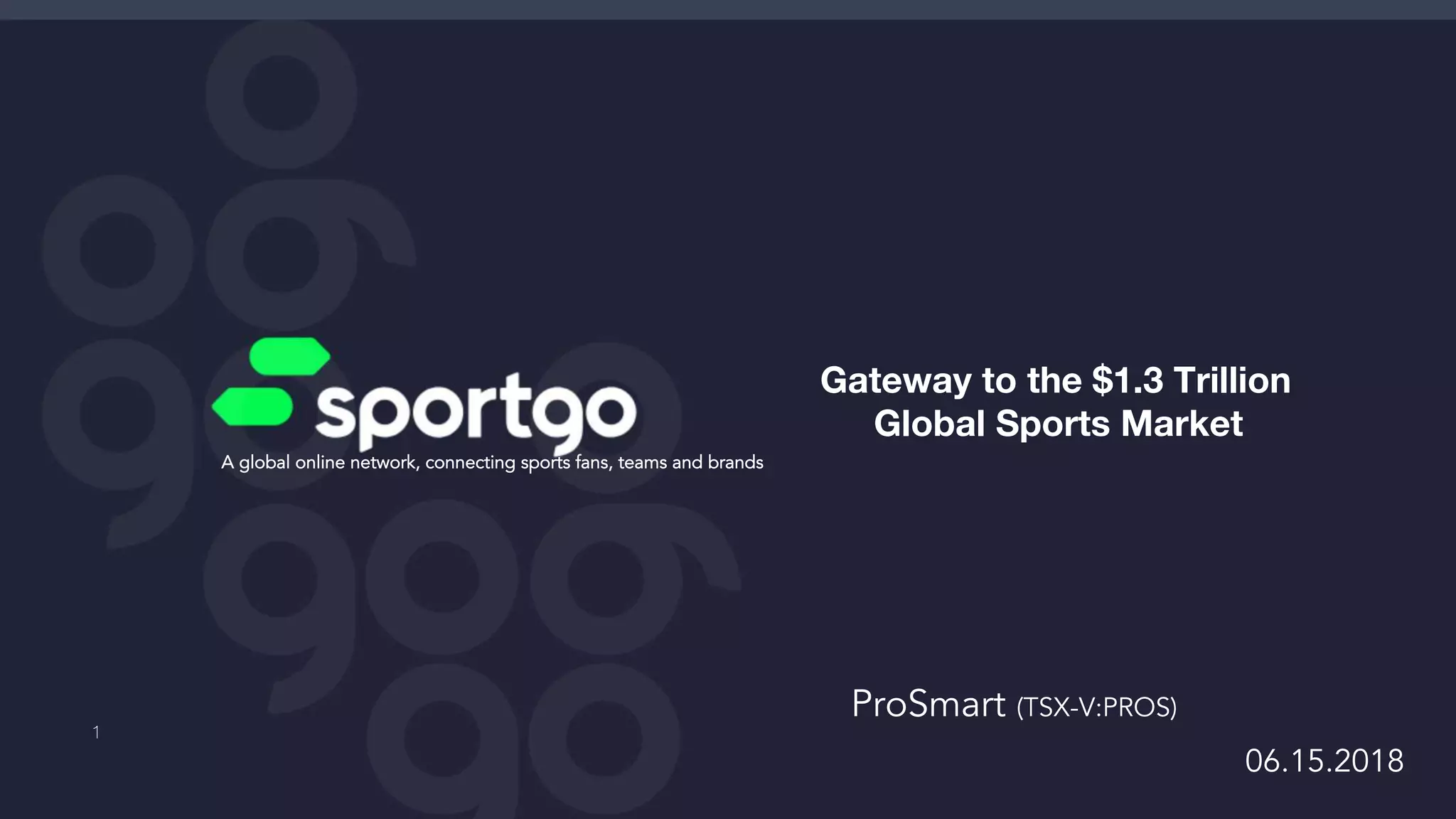
The opening slide introduces Sportgo as the "Gateway to the $1.3 Trillion Global Sports Market." It defines the platform as a "global online network, connecting sports fans, teams and brands." The slide also clearly identifies the parent company, ProSmart, and its public listing on the TSX-V. The date, June 15, 2018, establishes the context of the presentation during a period of significant digital transformation in sports media.
Slide 3: About Us and Product Interface
This slide provides a high-level overview of the Sportgo platform. It is described as a digital platform delivering "world-class content and tools for players, fans and coaches." Key features mentioned include:
Training videos and skills development content. · Team connectivity and administration tools. · A combination of user-generated content and professional sports news.
The slide includes several UI mockups showing a feed-based social interface, video player screens for "Skill Videos," and community group pages. The visual emphasis is on a mobile-responsive, content-heavy experience similar to established social networks but tailored for athletic instruction and team management.
Slide 5: The Market Opportunity
Slide 5 attempts to quantify the problem Sportgo is solving. It identifies a massive audience: 1 billion+ youth and recreational players and a $1.3 trillion total market. The core argument is that the market is "fragmented and in need of a solution." Supporting data points include:
NFL viewership down 7.5% year-over-year. · Sports TV networks losing viewers and revenue. · 850 million sports fans on Facebook and 200 million on Instagram. · 60% of Twitter's traffic being sports-related.
The slide argues that while sports fans are active on general social media, they lack a "sophisticated" destination specifically designed for the sports vertical.
Slide 7: The Four Pillars of the Business Model
ProSmart outlines its strategy through a concentric circle diagram labeled "A New Model That's Winning." The four pillars are:
Educate: Building player and coaching development content. · Equip: Linking training content with team administration technology. · Build Community: Launching a network platform for global reach. · Build Marketplace: Enabling brands and sponsors to reach the community through branded content.
This slide suggests a multi-faceted revenue approach, though it does not explicitly break down the percentage of revenue expected from each pillar.
Slide 9: Competitive Positioning
Using a Venn diagram, Slide 9 places Sportgo at the intersection of "Interests/Pastimes" and "Professional/Career," alongside platforms like Pandora, Flixster, and Classmates. It distinguishes Sportgo from "Family & Friends" networks like Facebook, Instagram, and Snapchat. The slide claims a target of 1.5 billion+ sports fans, positioning Sportgo as the dedicated "community of interest" for this demographic.
Slide 11: The China Expansion Strategy
A significant portion of the deck is dedicated to the Chinese market. The slide highlights the "Unrivalled China Opportunity" tied to the 2022 Olympic Winter Games in Beijing. Key strategic points include:
Integration with WeChat to accelerate user growth. · Capitalizing on the $3.9 billion mandated government spend on the Winter Olympics. · The construction of 650 new ice rinks and 70,000 soccer pitches. · The acquisition of DL (Doug Lynch) Hockey, which provides an established brand and physical hockey clubs in China.
This slide represents the company's primary growth engine, moving from a pure software play to a hybrid model involving physical sports infrastructure and government-backed initiatives.
Slide 13: Shareholder Value Creation Potential
The final slide shown is a valuation matrix. It does not provide current revenue or user numbers. Instead, it presents a grid showing "Total Enterprise Value ($MM)" based on two variables: Monthly Active Users (MAU) and an EV/MAU multiple. The matrix covers:
MAU: From 4 million to 14 million. · EV/MAU: From $20 to $100.
For example, the slide indicates that at 10 million MAUs and a $60/user multiple, the enterprise value would be $600 million. This is a common tactic for early-stage or pre-revenue companies to project future worth, but it highlights the lack of current traction data in the presentation.
What Works in This Deck
Clear Vertical Focus: The deck successfully argues that while sports fans are on Facebook and Twitter, those platforms are not built for the specific needs of coaches and players (e.g., training videos and team management). By focusing on the "recreational player" segment, they identify a niche that general social media serves poorly.
Strategic Acquisition: The mention of the DL Hockey acquisition on Slide 11 is a strong proof point. It shows the company is not just building an app in a vacuum but is actively acquiring the domain expertise and physical footprint necessary to succeed in a complex market like China.
Macro-Trend Alignment: The deck does a good job of tethering its success to massive external events, specifically the Beijing 2022 Olympics and the broader shift of audiences away from linear television. This creates a sense of urgency and inevitability for the platform.
What Is Missing from This Deck
Actual Traction Metrics: The most glaring omission is the absence of current user data. While Slide 13 shows what the company could be worth with 4 million to 14 million users, it never states how many users Sportgo actually had in June 2018. Without a baseline, the projections are purely speculative.
The Team: In the seven slides provided, there is no mention of the leadership team, their backgrounds in sports tech, or their experience in the Chinese market. For a company operating in both the digital and physical (hockey camps) space, the "who" is as important as the "what."
Financial Health: As a public company (TSX-V:PROS), investors would expect to see a summary of the balance sheet, burn rate, or revenue growth. The deck focuses entirely on the "opportunity" and "potential" rather than the current financial reality.
The Ask: There is no slide detailing how much capital is being sought or how the funds will be allocated between the China expansion, product development, and marketing.
Founder Takeaways
Use Valuation Matrices Cautiously: The matrix on Slide 13 is a double-edged sword. While it helps investors visualize the upside, it can also look like a distraction if not accompanied by current growth rates. If you use a theoretical valuation table, ensure you are also showing the month-over-month growth that proves you are on the path to those numbers.
Localize Your Global Strategy: The China slide is the strongest part of the deck because it isn't just a "we will launch there" statement. It includes specific local partnerships (WeChat), local infrastructure (rinks/pitches), and a local acquisition (DL Hockey). When pitching international expansion, specificity is your best friend.
Define Your 'Community of Interest': Slide 9's Venn diagram is a useful way to explain why a new social network is needed in a world dominated by giants. By categorizing Facebook as "Family & Friends" and Sportgo as "Interests/Pastimes," the founders create a logical space for their product to exist without needing to "kill" the incumbent social networks.
Frequently asked questions
- What is the primary product being pitched?
- The primary product is Sportgo, owned by ProSmart. It is described on Slide 3 as a 'globally accessible digital platform' that provides training videos, team connectivity tools, and a social network for players, fans, and coaches. It aims to be a centralized hub for sports content that is currently fragmented across various social media and TV networks.
- How does the company justify the market opportunity?
- On Slide 5, the company points to a $1.3 trillion global sports market and notes that traditional sports TV networks are losing viewers and money rapidly. They cite a 7.5% year-over-year decline in NFL viewership as evidence of fragmentation, suggesting that fans are moving online but lack a sophisticated 'go-to' destination.
- What is the strategy for the Chinese market?
- As detailed on Slide 11, the strategy involves integrating Sportgo with WeChat to access the $223 billion Chinese sports market. They are leveraging the 2022 Beijing Winter Olympics, the construction of 650 new ice rinks, and their acquisition of DL Hockey to build a user base through hockey schools and skills camps.
- What metrics does the deck use to project value?
- Instead of showing current revenue or user growth, Slide 13 provides a 'Shareholder Value Creation Potential' matrix. This table calculates Total Enterprise Value by multiplying Monthly Active Users (MAU) by an EV/MAU multiple. The chart shows potential valuations ranging from $80 million (4M MAU at $20/user) to $1.4 billion (14M MAU at $100/user).
- What critical information is missing from this deck?
- The deck is missing several standard investor components: a team slide showing leadership expertise, current financial statements or burn rate, specific user traction data (actual MAUs), and a clear 'Ask' slide detailing how much capital is being raised and how it will be spent.